The Technology Inside
Clawglasses
A transparent look at the engineering challenges, design decisions, and technical trade-offs behind our AI glasses.
Engineering Transparency
The specifications listed below represent our engineering targets for the production units shipping Q2 2026. Final specifications may vary based on manufacturing constraints and regulatory requirements. We commit to updating this page monthly with actual benchmarks from engineering samples.
Last updated: January 2026 · Next update: February 15, 2026
Hardware Architecture
Component-level breakdown of the WG1 system
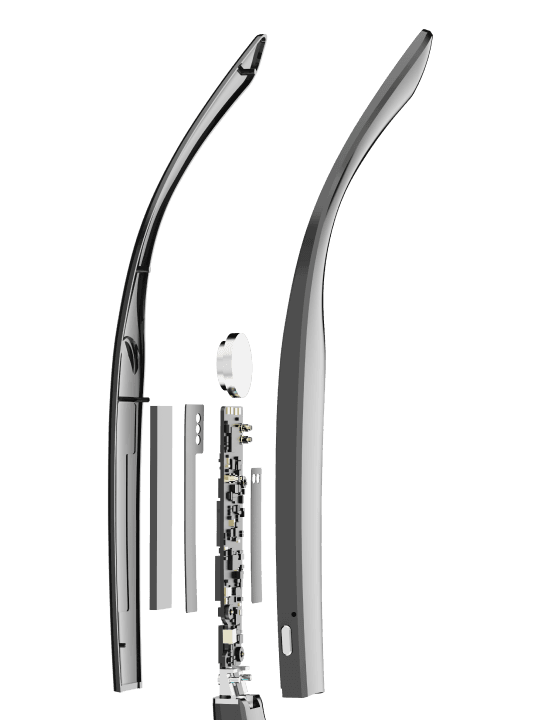
Precision Engineering
Every component is meticulously designed for optimal performance and comfort. The temple arms house our proprietary audio system and processing unit, while maintaining an ultra-slim profile.
39.96g
Ultra-lightweight
13MP
Camera sensor
Left Temple
- 2x MEMS Microphones
- Bone Conduction Speaker
- Touch Sensor Strip
- 550mAh Li-Po Cell
Bridge & Frame
- Titanium Alloy Frame
- Magnetic Charging Contacts
- Recording LED Indicator
- Adjustable Nose Pads
Right Temple
- Qualcomm QCC5171 SoC
- 12MP Sony IMX766 Camera
- NPU Co-processor
- Graphene Heat Spreader
Weight & Form Factor
Note: Final weight ~40g (bare frame). Total weight varies 42-48g depending on lens prescription options.
Battery & Power
Clarification: "12 hours" in marketing refers to audio-only recording mode. 4K video limited to 30-minute continuous segments due to thermal constraints.
Camera System
Privacy: Recording LED cannot be disabled by software. Hardware-enforced for regulatory compliance (EU, US, JP).
Thermal Management
Design Trade-off: 4K recording triggers thermal throttling after ~30 mins. 1080p can run continuously. AI inference is optimized to stay below thermal limits.
AI Processing Pipeline
How we handle on-device and cloud AI workloads
Capture
Audio/Video input
On-devicePre-process
Noise reduction, VAD
On-device NPUInference
ASR, Translation
HybridOutput
Text, Audio response
On-deviceProcessing Location & Privacy
✅ On-Device (Default)
- • Voice activity detection
- • Wake word recognition
- • Basic transcription (English)
- • Audio recording & storage
☁️ Cloud (Opt-in)
- • Multi-language translation
- • Advanced AI queries (GPT-4 tier)
- • DePIN data contribution
- • Digital Twin training
All cloud processing is opt-in. Users can operate fully offline with reduced AI capabilities. See our Privacy Architecture for encryption details.
Optical System
Display technology and lens options
Audio-First Design
WG1 is designed as an audio-first AI wearable. Unlike AR glasses with complex waveguides, WG1 uses bone conduction audio for AI responses, keeping the glasses lightweight and affordable.
WG2 with HUD Display
Our next-generation glasses will feature a micro-LED HUD for real-time translation subtitles and navigation prompts. Currently in prototype phase.
- • Monochrome green micro-LED
- • 15° field of view
- • Text-only display
- • Estimated +$100 MSRP
Manufacturing & Quality
Our production partners and quality standards
Production Partner
Contracted with established ODM in Shenzhen with 15+ years in wearables manufacturing.
Previously manufactured for major US/EU brands
Certifications
Targeting FCC, CE, UKCA, and MIC certifications for global market access.
Certification process begins Q1 2026
Warranty & Support
1-year limited warranty covering manufacturing defects. US-based support team.
RMA process via World App
Technical Documentation
Download detailed specifications, API documentation, and hardware guides.
API Documentation coming February 2026
Questions About Our Technology?
We believe in transparency. If you have technical questions not covered here, reach out to our engineering team.